VLAN Segmentation Is Where Most Medical Device Integrations Quietly Break
After years of standing between hospital network teams and medical device vendors, I've come to a frustrating conclusion. The integrations that fail loudest, the ones that get escalated to the CMIO at 2 a.m., almost always trace back to a VLAN decision someone made months earlier. Not a bad decision necessarily. Just one made without…


After years of standing between hospital network teams and medical device vendors, I’ve come to a frustrating conclusion.
The integrations that fail loudest, the ones that get escalated to the CMIO at 2 a.m., almost always trace back to a VLAN decision someone made months earlier. Not a bad decision necessarily. Just one made without the full picture.
VLAN segmentation is supposed to make hospital networks safer, more performant, and easier to manage. And it does.
But it also quietly breaks things. Things that used to work. Things vendors swore would keep working. Things clinicians depend on without ever knowing a network exists.
This post is a field-level account of what I’ve seen go wrong, what I’ve learned from cleaning it up, and what I wish every team approaching VLAN segmentation knew before they started drawing diagrams.
What Is VLAN Segmentation and Why Hospitals Use It
A VLAN is a logical partition of a physical network. Two devices plugged into the same switch can be made to behave as if they’re on entirely separate networks, unable to see or talk to each other without explicit routing rules.
In a hospital, that VLAN segmentation capability is enormously useful. It lets a single physical infrastructure carry traffic for imaging, monitoring, guest Wi-Fi, building automation, and EHR access without those worlds colliding.
The concept is simple. The implementation in a clinical environment is anything but.
Why Flat Networks Fail in Modern Healthcare Settings
I still walk into hospitals running surprisingly flat networks.
Everything talks to everything. The justification is usually historical, since it worked fine when there were forty connected devices per floor and now there are four hundred.
Flat networks fail in healthcare for three predictable reasons. Broadcast traffic from discovery protocols overwhelms older devices. A single compromised workstation can reach an MRI console. And troubleshooting becomes archaeology, with no one quite sure which device is generating which traffic.
Key Drivers Behind VLAN Adoption in Hospitals
Typically hospitals adopt VLAN segmentation for a mix of reasons. Security audits flag the flat network. A ransomware incident at a peer institution gets the board’s attention. A new medical device deployment forces a redesign. Sometimes it’s simply that the existing network can no longer scale.
The driver matters because it shapes the segmentation strategy. A security-driven project looks very different from a performance-driven one, and that difference shows up later in how well medical device integrations survive the cutover.
How Hospital Network Teams Approach VLAN Design
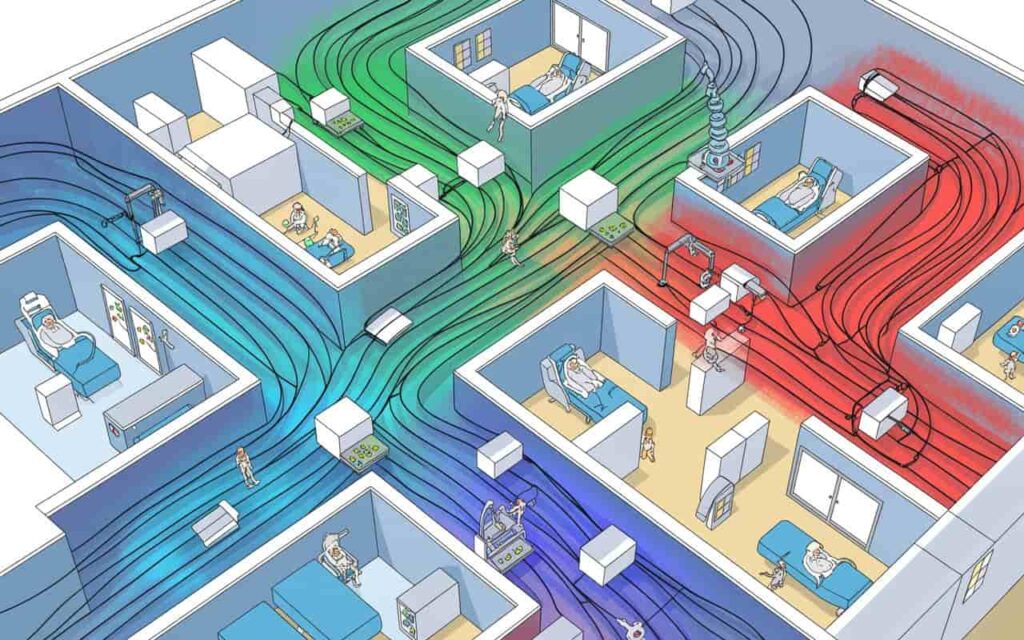
Most hospital networks I’ve audited have some variation of the following segments.
Clinical workstation VLANs for EHR access. Server VLANs for the data center. Medical device VLANs, often subdivided by modality. Guest and patient Wi-Fi. Building management for HVAC, badge readers, and elevators. Voice for phones and nurse call. And increasingly, a separate IoT or “untrusted” VLAN for everything that doesn’t fit neatly elsewhere.
The trouble starts when medical devices get lumped into that last category by default.
Separating Clinical, Administrative, Guest, and IoT Traffic
The separation logic is straightforward on paper. Patient-facing clinical traffic deserves the highest reliability and tightest security. Administrative traffic can tolerate more variability. Guest traffic should be isolated entirely from anything internal. IoT traffic should be locked down because it tends to be the weakest link.
Where it gets messy is that medical devices stubbornly refuse to fit any one category cleanly. A networked infusion pump is clinical, but it behaves like IoT. A patient monitor is clinical and time-sensitive, but its middleware lives in the data center. A bedside ultrasound is mobile, wireless, and roams between units.
The neat categories collapse the moment real devices arrive.
The Role of Network Architects and Infrastructure Teams
Network architects are usually doing their best with partial or at least incomplete information.
They’re handed and archaic diagram or device list, sometimes accurate, sometimes years out of date. They’re told which VLANs to create based on a security framework. And they’re expected to make it all work without disrupting clinical operations.
The piece they almost never get is a clear picture of how devices actually communicate. Which servers they reach out to. Which ports they need open. Which discovery protocols they depend on.
That information lives with the vendors, the biomed team, and the integration engineers, and it rarely makes it into the network design document when these teams don’t collaborate.
VLAN Segmentation from the Medical Device Perspective
This is where I spend most of my time, and where the most painful lessons live due to skipping out on the collaboration mentioned above.
How Devices Are Assigned to VLANs During Deployment
In theory, a device gets assigned to a VLAN based on its function, security posture, and integration requirements.
In practice, devices get assigned based on which switch port the IT tech happened to plug them into, or which VLAN was “default” on the floor when the device was installed, especially when not discussed early in a project or deployment.
I’ve seen hospitals where identical patient monitors on different floors ended up on different VLANs because the deployments happened years apart under different network policies. The monitors all worked. Until they didn’t.
When central monitoring software was upgraded, half the units could reach the new server and half couldn’t, and no one had documented why.
Static IP, DHCP, and Reservation Considerations for Medical Equipment
Medical devices have an uncomfortable relationship with DHCP.
Many vendors require static IPs because their software was written before DHCP reservations were reliable, or because they integrate with systems that expect fixed addresses. Others use DHCP but break in subtle ways when leases expire at inconvenient times.
The lesson I’ve learned repeatedly is that DHCP reservations are almost always the right answer, but only if the network team and biomed team agree on who owns the reservation list.
When ownership is unclear, reservations get deleted during cleanup, devices get new IPs, and integrations break silently. The device still pings. The data just stops flowing.
Modality-Specific VLAN Placement (Imaging, Patient Monitoring, Infusion, Lab)
Different modalities have genuinely different network needs.
Imaging devices generate huge bursts of DICOM traffic and need sufficient bandwidth and low-latency paths to PACS. Patient monitoring needs deterministic, low-jitter connectivity and often uses multicast for waveform distribution. Infusion pumps need reliable but low-bandwidth connectivity to drug library servers. Lab analyzers often speak ASTM or HL7 to middleware that may live on entirely separate segments.
Putting all of these on a single “medical device VLAN” is a common mistake. It’s better than a flat network, but it ignores that these workloads have incompatible requirements.
A misbehaving imaging device can flood a VLAN with traffic that disrupts monitoring waveforms on the same segment.
What Biomedical and Clinical Engineering Teams Need to Know
Biomed teams are often the last to learn about a VLAN change and the first to get blamed when devices stop working.
The most successful hospital systems I’ve worked at treat biomed as a peer of MDI and network engineering, not a downstream consumer of network decisions.
Practically, that means biomed needs read access to the network documentation, a standing seat in change management, and a clear escalation path when device behavior changes after a network update.
This means network teams have to accept that biomed will sometimes veto a segmentation change because of a vendor requirement they couldn’t have predicted.
Security Benefits of VLAN Segmentation in Healthcare
The strongest argument for VLAN segmentation is containment.
When a workstation in the business office gets compromised, segmentation determines whether the attacker can pivot to the imaging network or whether they hit a wall. Every major healthcare ransomware incident in the past five years has had lateral movement as a critical factor, and segmentation is the single most effective control against it.
Protecting Legacy Devices That Cannot Be Patched
Healthcare frequently runs on legacy. Devices certified a decade ago, running operating systems that haven’t received security updates in years, are still in active clinical use because they work and replacing them costs millions. VLAN segmentation is often the only realistic compensating control for these devices.
The lesson here is that segmentation buys time, not safety. A legacy ventilator on its own VLAN with strict ACLs is still a legacy ventilator. The segmentation just makes it harder to reach.
Supporting HIPAA, HITRUST, and IEC 80001 Compliance
Auditors love VLAN diagrams. They map cleanly to the segmentation requirements in HIPAA’s technical safeguards, HITRUST’s network controls, and IEC 80001’s risk management framework for IT networks incorporating medical devices.
What auditors sometimes miss is whether the segmentation actually works as documented. I’ve seen plenty of beautiful diagrams that didn’t match the running configuration.
The diagram passes the audit. The network doesn’t actually enforce what the diagram describes.
Reducing the Attack Surface for Connected Medical Devices
A well-segmented medical device VLAN limits inbound traffic to exactly the systems that need to reach it. The integration engine. The middleware. The clinical application server. Everything else gets blocked at the routing layer.
Done well, this reduces the attack surface enormously. Done poorly, it breaks integrations and gets rolled back under clinical pressure.
Data Flow and Integration Considerations Across VLANs
HL7, DICOM, and FHIR Traffic Across Segmented Networks
Most medical device integration traffic is either HL7 over MLLP, DICOM, or increasingly FHIR over HTTPS. Each has different segmentation implications.
HL7 over MLLP typically uses long-lived TCP connections on non-standard ports. Firewalls between VLANs need to allow those connections and, critically, not drop them during idle periods.
I’ve spent too many hours debugging interfaces that worked fine for six minutes and then died, only to find a firewall with an aggressive idle timeout sitting between the device and the integration engine.
DICOM is bandwidth-heavy and uses negotiated ports for some operations. Strict inter-VLAN routing can interfere with DICOM in unexpected ways, especially for older modalities that don’t behave well with stateful firewalls.
FHIR is the easiest to segment because it uses standard HTTPS, but it introduces new challenges around certificate management and API gateway placement across VLAN boundaries.
Firewall Rules, ACLs, and Inter-VLAN Routing
The rule of thumb I share with network teams is that every inter-VLAN integration deserves an explicit, documented rule. Not a broad permit. Not a default route through a firewall. A specific rule that says this source talks to this destination on this port for this clinical purpose.
This is tedious. It’s also the only way to maintain segmentation over time.
Broad rules accumulate. Documentation rots. Within two years, no one remembers why a particular port is open, and no one is willing to close it because something might break.
Working with EHR, PACS, and Middleware Systems Across Segments
The EHR, PACS, and middleware platforms are the gravitational centers of medical device integration. Almost every device eventually needs to talk to one of them.
VLAN designs that don’t carefully plan the paths between device segments and these platforms create chronic problems.
My strongest recommendation here is to design the integration paths first and the segmentation second. Start with a map of which devices need to reach which platforms, then build VLANs that accommodate those paths.
Designing VLANs in the abstract and then trying to fit integrations through them is how teams end up with thirty firewall exceptions and a segmentation strategy that exists mostly on paper.
Avoiding Broken Integrations Due to Misconfigured VLANs
The most common failure mode I see is asymmetric routing.
Traffic goes out one path and returns another, and a stateful firewall in the middle drops the return traffic because it didn’t see the original request. Devices appear to be working. Pings succeed. But application traffic mysteriously fails.
The second most common is multicast leakage or starvation. Patient monitoring systems often rely on multicast for central station communication, and multicast across VLANs requires explicit configuration that’s easy to miss.
Common Challenges When Implementing VLANs for Medical Devices
Vendor Requirements That Conflict With Segmentation Plans
Some vendors still ship documentation that says “place this device on a flat network with the server.”
That advice is two decades old and clinically irresponsible at this point, but it’s what the documentation says, and biomed teams reasonably want to follow vendor guidance.
The lesson is to push back. Engage the vendor’s technical team, not just the implementation specialist. Most vendors can support segmented networks, but the knowledge lives deep in their engineering organization and rarely surfaces in front-line documentation.
Multicast, Broadcast, and Discovery Protocol Issues
mDNS, SSDP, LLDP, and proprietary discovery protocols all assume devices and their controllers are on the same broadcast domain.
Segment them and discovery breaks. The fix is either to enable multicast routing carefully, deploy discovery proxies, or move to vendor solutions that support unicast configuration.
This is where I’ve seen the most “we segmented and nothing works” moments. The devices boot. They get IPs. They just can’t find each other.
Wireless Medical Devices and SSID-to-VLAN Mapping
Wireless medical devices add a layer of complexity.
Each SSID maps to a VLAN, and the mapping has to be consistent across every access point in the hospital. Roaming devices that change access points must maintain their VLAN assignment, or sessions drop and integrations break.
I’ve seen telemetry monitors lose connectivity every time a patient was moved between units because the SSID-to-VLAN mapping wasn’t consistent across buildings. The fix was a coordinated rework of the wireless infrastructure, which took months.
Handling Mobile Carts, Tablets, and Roaming Workflows
Workstations on wheels, point-of-care testing devices, and tablets used for medication administration all roam. They cross physical and logical boundaries constantly.
VLAN designs that assume devices stay put will break these workflows.
The pragmatic answer is usually a dedicated mobile clinical VLAN with broad geographic reach, accepting some segmentation compromise in exchange for workflow continuity.
Best Practices for Network and Integration Teams
Building a Medical Device Inventory Before Segmenting
You cannot segment what you cannot inventory.
Every segmentation project I’ve seen succeed started with an accurate device inventory, ideally enriched with communication patterns. Every segmentation project I’ve seen fail started with an out-of-date asset list and an assumption that the network team could figure out the rest.
Invest in the inventory before the design. Use passive network monitoring, biomed asset databases, and direct vendor engagement to build it.
The inventory is the foundation. Skip it and everything else wobbles.
Collaborating Across IT, Biomed, Security, and Clinical Stakeholders
The hospitals that segment well have regular working sessions between network, biomed, security, and clinical informatics.
Not a project kickoff and a go-live. Ongoing collaboration.
These teams have overlapping but distinct expertise, and the gaps between them are exactly where integrations break.
Documentation, Change Management, and Ongoing Audits
Document the segmentation as it actually is, not as it was designed to be.
Audit the running configuration against the documentation quarterly. Treat every firewall rule change as a clinical change with appropriate review, because that’s what it is when medical devices are involved.
Testing Integrations Before Go-Live in a Segmented Environment
If you have a test environment that doesn’t mirror production segmentation, your integration testing is incomplete.
I’ve watched go-lives fail at 6 a.m. because the test integrations were running on a flat lab network and the production network had segmentation rules no one validated against.
The Future of VLAN Segmentation in Healthcare
Microsegmentation and Zero Trust in Clinical Networks
Traditional VLANs are coarse.
A medical device VLAN with a hundred devices on it still lets those devices talk to each other freely. Microsegmentation pushes the boundary down to the individual device or workload, enforcing policy regardless of physical or VLAN location.
For healthcare, this is the direction. It’s harder to implement, but it solves problems that VLANs alone never will, like preventing a compromised infusion pump from talking to other infusion pumps on the same segment.
Software-Defined Networking and the Move Beyond Traditional VLANs
SDN approaches let segmentation policy follow the device rather than depending on switch port configuration.
For mobile clinical devices, this is transformative. The device gets the same policy whether it’s on the cardiac floor or the ER, without manual VLAN reassignment.
Adoption in healthcare has been slow, partly because the existing infrastructure investment is enormous and partly because clinical risk tolerance for new networking paradigms is low. But it’s coming.
How Medical Device Vendors Can Support Better Segmentation
The most helpful thing vendors can do is publish clear, current documentation of network requirements.
Source and destination ports. Protocols. Multicast dependencies. Behavior under packet loss. Behavior when DNS is unreachable. This information should be readily available, not extracted from support engineers over weeks of email threads.
Vendors who do this well make segmentation projects faster, safer, and cheaper. Vendors who don’t are quietly contributing to every failed integration their devices participate in.
Final Thoughts for Medical Device Integration Teams
VLAN segmentation isn’t going away, and it shouldn’t. The clinical, security, and operational case is overwhelming.
What needs to change is how we approach it.
Treat segmentation as a clinical change, not just a network change. Build the inventory before the design. Map the integration paths before drawing the VLANs. Document what actually runs in production, not what was planned.
And make sure biomed, network, security, and integration teams are talking to each other before the project starts, not after the first outage.
The integrations that break quietly are the ones that hurt most. They don’t trigger alarms. They don’t page anyone.
They just slowly degrade clinical workflows until someone notices that the data stopped flowing three weeks ago and no one can figure out why.
Get the segmentation right, and most of these failures never happen. Get it wrong, and you’ll spend years cleaning it up.
The choice, in my experience, is almost always made in the first few weeks of a project, by people who don’t yet know what they’re choosing between.