FHIR Is Not a Software Update. It Is an Additive Layer. Your Executive Does Not Know the Difference Yet.
Skip the textbook comparison. This MDI-focused breakdown covers where FHIR breaks in production, where HL7 v2 still dominates, and what hospital executives keep getting wrong about both.

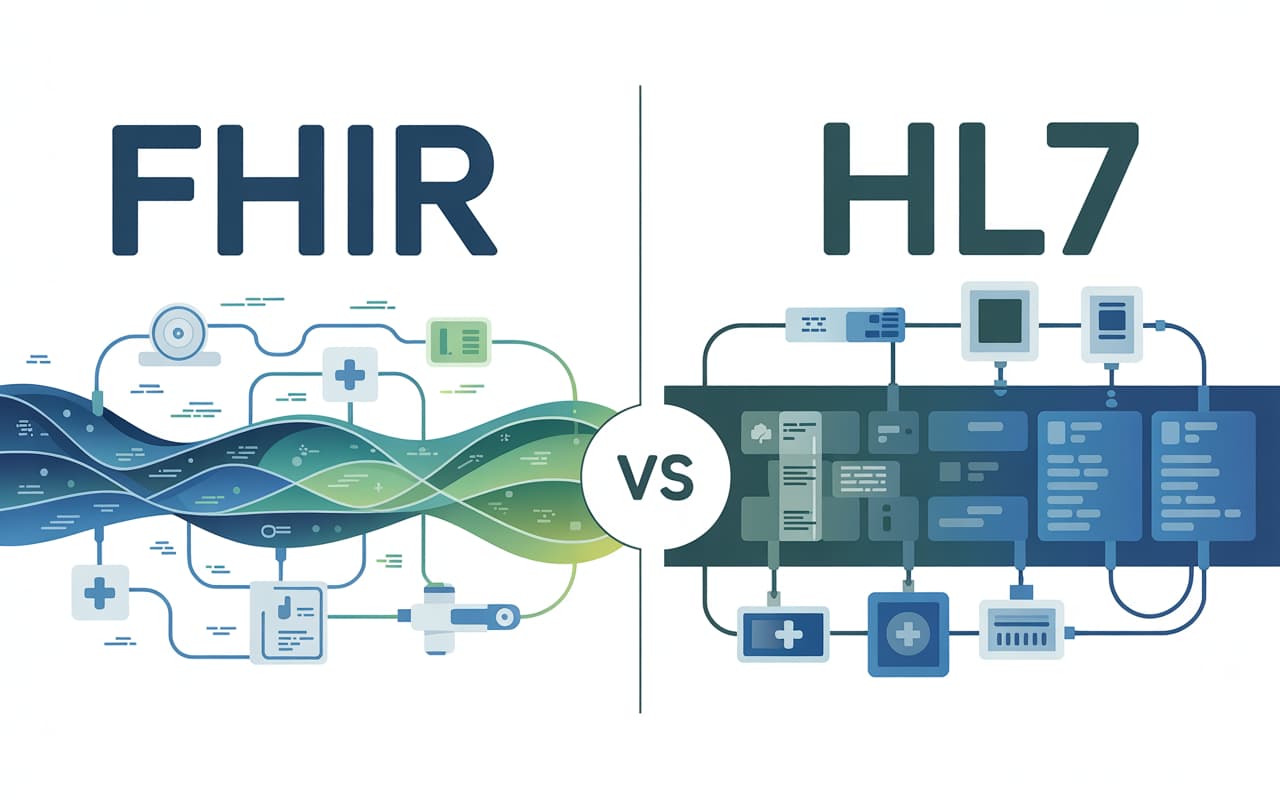
If you’ve been in medical device integration for more than a few years, you’ve sat through at least one executive briefing where someone declared FHIR the definitive future of healthcare interoperability. They weren’t wrong, exactly. But they also weren’t the ones who had to reconcile a FHIR R4 endpoint with a 2003 ADT message stream at 2am during a go-live. That gap between strategic vision and operational reality is where MDI professionals live. And it’s why the FHIR vs HL7 conversation deserves a more honest treatment than it typically gets.
This isn’t a tutorial. You already know what a resource is and what a segment looks like. This is about architectural consequences, operational pain, and the political dynamics that shape which standard you can actually deploy in a given environment.
What HL7 v2 Actually Gets Right
HL7 v2 is ugly. The pipe-delimited format is a relic, the optionality is a documentation nightmare, and the lack of enforced semantics means two “compliant” systems can still fail to interoperate. Everyone in this industry knows that. And yet HL7 v2 handles 80 to 90 percent of live clinical messaging traffic in most U.S. health systems today. That isn’t inertia alone.
The protocol is operationally battle-hardened. It tolerates malformed data gracefully. It has predictable ACK/NACK behavior. Every middleware engine your hospital has, from Cloverleaf to Mirth to Corepoint, was built around it. The HL7 v2 message for a device observation or a patient transfer is understood at every layer of the stack, by every analyst, by every vendor support team you call at midnight. There is substantial value in that shared fluency.
More specifically for device integration: ORU^R01 remains the dominant message type for point-of-care device output. Vital sign monitors, infusion pumps, ventilators, and nearly every connected device still speaks v2 at the protocol layer. If you’re building a device integration architecture today, you are not choosing between FHIR and HL7 v2. You are managing both.
Where FHIR Creates Real Architectural Advantages
FHIR’s value is clearest in contexts where you need structured, queryable, interoperable data beyond point-to-point messaging. The REST-based approach, the standardized resource model, and the alignment with modern web development practices make FHIR genuinely superior for several real-world use cases.
Clinical decision support integration benefits enormously from FHIR. When a device’s output needs to feed a CDS Hooks workflow or populate a SMART on FHIR application, you want an Observation resource, not a parsed ORU segment. Patient-facing applications that need to pull data from multiple systems hit FHIR APIs far more cleanly than they would negotiate disparate v2 interfaces. And for longitudinal device data that needs to persist in a structured clinical record, FHIR’s Observation and DeviceMetric resources offer a semantic richness that v2 simply cannot match.
The other underappreciated advantage is developer onboarding velocity. A software developer who has never touched healthcare can begin working with a FHIR API in days. Getting the same person productive with HL7 v2 parsing, custom segment handling, and interface engine logic takes weeks. For organizations building internal tooling, that gap matters.
Where FHIR Actually Breaks
Here is what the conference presentations skip. FHIR is not production-hardened in the same way v2 is, and the failure modes are less forgiving.
Profile fragmentation is the first operational trap. The base FHIR specification is intentionally permissive. Implementation guides like US Core and Da Vinci narrow it, but two systems claiming FHIR R4 compliance can still be completely incompatible at the data level. You will spend significant time negotiating profiles, validating against them, and handling the inevitable gaps between what a vendor claims to support and what their API actually delivers.
Versioning creates real integration debt. FHIR has moved from DSTU2 through R4 and into R5, and the breaking changes between versions are non-trivial. If you built a device integration layer against an R3 endpoint two years ago, you are now maintaining a translation layer that no one budgeted for.
Error handling is underspecified. HL7 v2 has a defined ACK/NACK pattern with application error codes that have real operational meaning. FHIR’s OperationOutcome resource is flexible but inconsistently implemented. In high-volume device data workflows, poor error transparency causes lost data and extremely difficult debugging sessions.
Finally, FHIR’s transaction performance at scale is still an open problem for many vendors. Bulk device telemetry, high-frequency vital sign data, and real-time alarm feeds are not problems FHIR REST was designed to solve. You will eventually reach for HL7 v2 or a streaming protocol like MQTT or FHIR Subscriptions, and that architectural complexity does not go away just because FHIR is in the name.
The Political Reality Inside Hospitals
No technical conversation about standards exists in a vacuum. Understanding who controls the interface engine, who owns the EHR contract, and where IT governance sits will shape what you can realistically deploy more than any standards comparison.
Most health system CIOs are under pressure to demonstrate FHIR adoption, in part because of ONC’s information blocking rules and the 21st Century Cures Act compliance requirements. This creates a surface-level FHIR mandate that often doesn’t extend to device integration. The EHR team is building FHIR APIs for patient data access. The HTM team is still connecting devices over HL7 v2 to the same EHR’s clinical data repository. Both are correct given their constraints.
Where this creates friction is when a device vendor pitches FHIR-native integration to an executive who then makes it a procurement requirement, without consulting the integration team. You end up contractually obligated to a FHIR pathway for a device that your infrastructure is not ready to support, or that the EHR’s device integration module doesn’t actually consume via FHIR in the way the vendor implied.
The constructive move here is to get ahead of these conversations. Build a clear internal position document on where your environment supports FHIR today, what the v2 dependencies are and why they exist, and what the realistic migration timeline looks like. It does not prevent all executive decisions from landing sideways, but it gives you something to reference when they do.
What Executives Misunderstand
The most common misunderstanding is that FHIR replaces HL7 v2 the way a new software version replaces an old one. It does not. The installed base of v2 infrastructure is enormous, the device ecosystem still runs on it, and the operational expertise embedded in your integration team and your vendor relationships is built around it. FHIR is an additive layer for most organizations, not a replacement.
The second misunderstanding is that FHIR compliance is a binary state. It is not. A vendor can be FHIR R4 compliant and still be nearly impossible to integrate with because of profile divergence, missing capabilities, or incomplete implementation guide support. Due diligence on FHIR integrations requires the same rigor as any v2 interface specification process, not less.
The practical implication for MDI professionals is that your credibility in these conversations comes from specificity. Not “FHIR is complicated” but “our current device data pipeline sends 14,000 ORU messages per hour through a Rhapsody channel, and here is what a FHIR migration actually involves at each layer.” That specificity is what separates MDI expertise from general health IT commentary, and it is what moves these conversations from policy to architecture.
The Practical Position
The right frame is not FHIR versus HL7. It is FHIR and HL7, deployed intentionally across the right use cases. Use HL7 v2 where it already works, where device vendor support is solid, and where your operational team has deep competency. Build toward FHIR where you need structured queryability, where you are integrating with modern application ecosystems, and where the implementation guide support is sufficient to make it reliable.
The complexity in the middle, and there is always complexity in the middle, is what MDI professionals are actually paid to manage. The standards are tools. Your value is knowing which tool fits the actual problem in front of you, not the problem described in the product brief.