The Central Station Is Not Going Anywhere, But It No Longer Needs a Room
Telemetry virtualization is not replacing the physical central station. It is removing the requirement that it live in a room. Here is what integration teams need to know before making the switch.

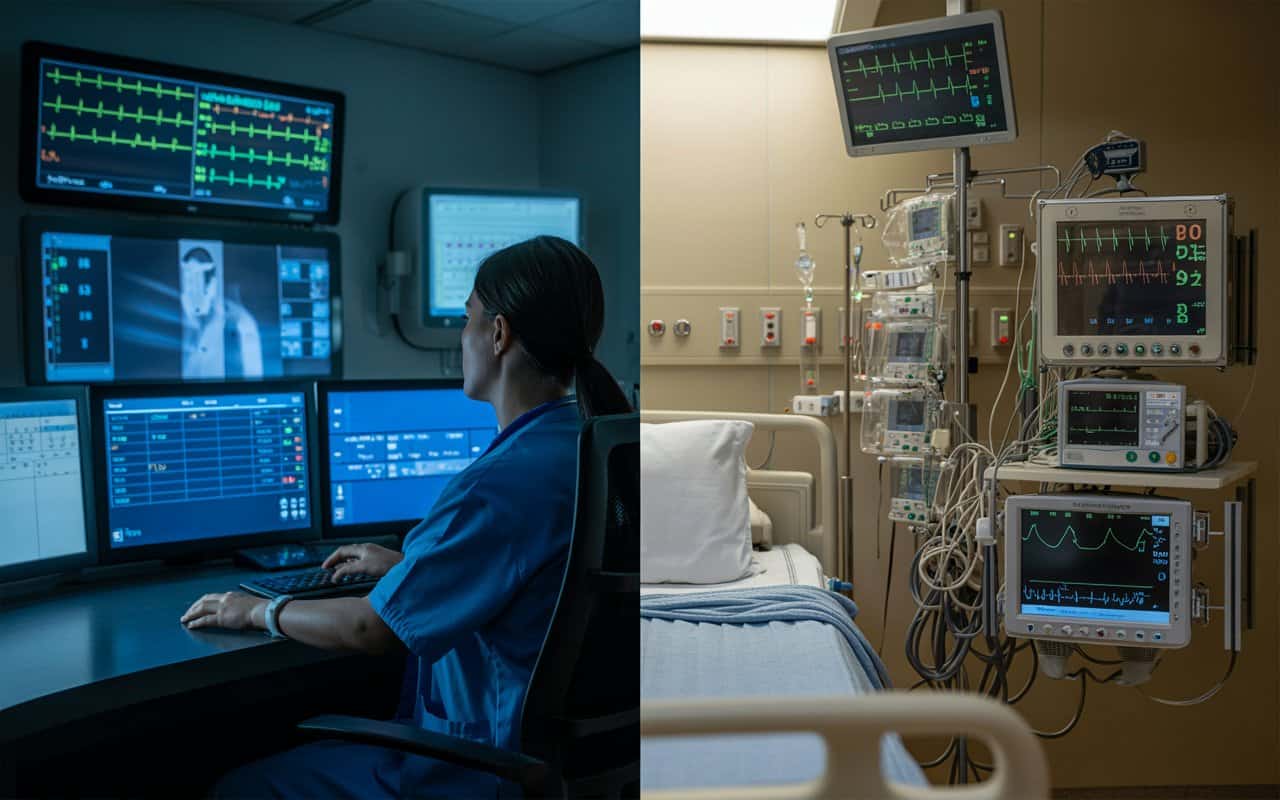
The central station is not going anywhere. After decades of anchoring telemetry monitoring in hospitals, it has earned its place in clinical workflows, clinical culture, and clinical trust. But the assumption that a central station requires a dedicated room, a wall of monitors, and a fixed address in your facility is one the industry has quietly started to dismantle. What is changing is not the concept of central monitoring. It is the requirement that it be physical at all.
Telemetry virtualization does not replace the central station. It liberates it. And understanding the difference between where we have been and where we are heading is increasingly important for anyone involved in medical device integration, clinical engineering, or health system infrastructure planning.
What is a physical central station and how does it work?
Traditional telemetry central stations are purpose-built hardware platforms supplied by the monitoring vendor running the system-level oversight for the hospital. Whether you are running Nihon Kohden, Philips, GE Carescape, or a comparable platform, the setup follows a familiar pattern: dedicated monitors and processing hardware installed either within a unit or in a centralized telemetry room, sometimes called a CTM Room or War Room, connected directly to the vendor’s VLAN and tied tightly to their proprietary data architecture.
Hardware, displays, and the nurse station model
The physical central station model places display monitors at the nurse station within a unit and, in larger facilities, duplicates that view inside a dedicated central telemetry room. It is a resilient setup that clinical staff know well and trust. That familiarity is a genuine asset.
But the model carries real constraints. When a central station fails, recovery depends entirely on having spare hardware on hand. There is no software fallback, no failover to another instance. You are waiting on parts and a technician.
Beyond failure scenarios, the physical footprint is significant. A desk outfitted with three or four central monitors consumes clinically valuable space in units where every square foot matters. Scale that across a facility with multiple units and hundreds of beds and the spatial cost becomes a genuine operational consideration.
How data flows from the patient to the display
Telemetry data travels from the patient-worn telemeter to the central station through one of two primary methods, each with its own trade-offs.
The more established approach uses installed RF radio antenna infrastructure. RF performs reliably within hospital environments, but expansion carries real cost and coordination overhead. Covering a new department or wing means new network runs, new RF antennas physically installed into the facility, and the work of integrating those back into the monitoring system. None of that happens quickly or cheaply.
The newer approach rides the hospital-grade wireless network. This makes scaling into any area your network team covers significantly more straightforward, but it introduces a different set of dependencies. Coverage gaps, changes in network configuration, and competing demands on shared infrastructure can all create downstream impact on telemetry reliability. The system’s performance is only as consistent as the network beneath it.
What is telemetry virtualization?
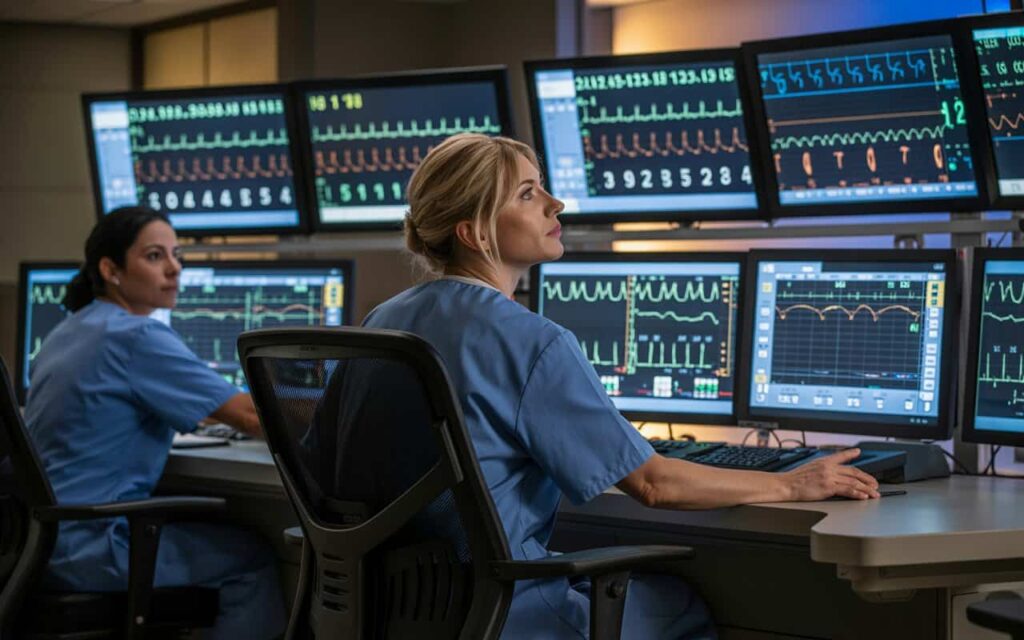
Virtualization moves the central station from a hardware platform to a software-defined instance running either on local server infrastructure in a data center or on cloud-based infrastructure. The monitoring logic, waveform display, alarm management, and configuration that previously required dedicated physical hardware now live in software. The room is optional. The station is not.
Software-defined monitoring and cloud or server infrastructure
One of the most immediate operational benefits of a virtual central station is what happens when something goes wrong. Physical centrals have discrete failure points. A failed component means diagnosing the hardware, sourcing a replacement, and waiting.
A virtual central running on server infrastructure does not carry that same risk profile. When a host has a problem, the virtual instance can be migrated or restored on a new host without the same time penalty. The recovery process looks more like an IT incident than a clinical equipment failure.
Since the virtual central station has no local display of its own, access is delivered through a client layer. Thin clients remain in use but the more current approach is browser-based access, which means anyone with appropriate credentials and network access can view telemetry from virtually anywhere in the health system. The monitoring capability is no longer tethered to a specific desk in a specific room.
How clinicians access waveforms and alerts remotely
In practice, a virtual central station can be accessed from a standard workstation, a tablet at the bedside, or a dedicated viewing station in a remote monitoring center. This opens the door to multi-unit monitoring from a single location, which is where health systems are beginning to realize staffing efficiencies that the physical model simply cannot match.
A remote telemetry technician monitoring multiple units across a campus, or even across facilities, is a legitimate operational model when virtualization handles the infrastructure layer.
Key differences between the two approaches
Infrastructure and total cost of ownership
Physical central stations represent capital expenditure with a defined hardware lifecycle. Monitors, processing units, and supporting infrastructure require planned refresh cycles, typically every five to seven years, along with ongoing maintenance contracts and spare parts inventory. The costs are predictable but significant, and they do not scale gracefully.
Virtual centrals shift much of this toward operating expense tied to server infrastructure or cloud licensing. The hardware refresh burden moves to the data center or cloud provider rather than sitting on the clinical engineering team. The up-front investment changes shape, though it does not disappear, and the total cost of ownership calculation depends heavily on existing infrastructure, vendor licensing models, and how aggressively a health system can consolidate monitoring operations.
Scalability and unit expansion
Adding monitoring capacity to a physical central station environment means buying hardware, finding space, and coordinating installation. Adding a floor or a new unit is a project with a timeline and a budget. In a virtualized environment, expanding capacity is largely a software and licensing conversation. New beds, new units, or even new facilities can be brought into the same monitoring environment without duplicating hardware across every location.
For health systems managing growth or operating across a distributed campus, this difference is material.
Alarm management and alert routing
Alarm fatigue is one of the most persistent and well-documented problems in telemetry monitoring. Physical central stations can support alarm configuration, but routing and escalation logic is often constrained by what the hardware platform supports and where staff are physically located to receive alerts.
Virtual platforms generally offer more flexible alarm routing, with configurable thresholds, escalation pathways, and the ability to push notifications to mobile devices or remote monitoring teams.
When the monitoring function is software-defined, the alarm management layer becomes more programmable. That flexibility does not automatically solve alarm fatigue, but it does create more tools to work with when designing workflows that reduce unnecessary alerting.
Integration with EHR and clinical systems
HL7, FHIR, and middleware considerations
Both physical and virtual central stations need to communicate with the broader clinical ecosystem, primarily the EHR, but also alarm notification systems, clinical documentation platforms, and increasingly, analytics tools. The integration pathway typically runs through HL7 messaging, FHIR APIs where vendor support exists, or middleware layers that translate between the monitoring system and downstream platforms.
Physical central stations often carry legacy integration architectures that were designed around on-premise connectivity. Virtual platforms, particularly those built on more current software foundations, tend to offer more native API surface and better alignment with modern interoperability standards. That said, vendor implementation varies significantly, and neither approach guarantees clean integration out of the box. The middleware layer remains a critical point of complexity regardless of which architecture you are working with.
Cybersecurity and network dependency risks
Virtualization introduces a different risk surface than physical hardware. A physical central station is largely self-contained. Its failure modes are hardware failures. A virtual central station depends on network availability, server infrastructure health, and the security posture of the systems it runs on. Expanding network access to support browser-based monitoring from anywhere in the health system also expands the attack surface.
This does not make virtualization less secure, but it does mean security and uptime considerations need to be addressed explicitly in the architecture.
Failover planning, network redundancy, access controls, and patch management all become part of the clinical system conversation in ways they were not when monitoring was isolated on dedicated hardware. IT and clinical engineering teams need a shared understanding of these dependencies before go-live, not after the first outage.
When does each approach make sense?
Scenarios where physical stations still win
High-acuity environments like cardiac ICUs or step-down units with complex patient populations often benefit from the immediacy and reliability of hardware that does not depend on network conditions or server availability. When clinicians need to be physically present at a monitoring location and the patient census is relatively stable, a physical central station is a known quantity that clinical staff have trained on and trust.
Facilities with limited IT infrastructure or constrained network environments may also find that the prerequisites for virtualization create more problems than the solution solves. Regulatory and accreditation considerations in certain care settings can also constrain architectural choices in ways that favor established hardware-based approaches.
Where virtualization gives health systems an edge
Multi-campus health systems managing telemetry across several facilities are the clearest use case for virtualization. The ability to consolidate monitoring into a regional center, extend coverage without duplicating hardware at each site, and staff monitoring operations more efficiently across a distributed footprint is a genuine operational advantage that the physical model cannot replicate.
New construction is another natural fit. When designing a facility from the ground up, there is no legacy hardware to work around and no staff retraining burden tied to displacing familiar equipment. Virtualization can be designed into the infrastructure plan from the start rather than retrofitted into a physical footprint that was built around a different model.
Lastly, staffing flexibility is also a factor, particularly for health systems looking to support centralized remote monitoring programs that cover multiple units or facilities from a single team.
What integration teams need to evaluate before making the switch
The decision to move toward a virtual central station is as much an infrastructure readiness question as a clinical one. Before committing to a migration, integration teams should honestly assess network redundancy and uptime guarantees, since the monitoring system will depend on network availability in ways it previously did not. Server infrastructure capacity and failover architecture need to be clearly defined, along with the plan for what happens when a host goes down.
Device compatibility with the intended virtual platform matters more than vendors sometimes let on in early conversations. Not every telemeter or bedside monitor integrates cleanly with every virtual central station, and discovering those gaps during implementation rather than during procurement is a painful and expensive lesson. Staff training timelines need to account for the shift in how monitoring is accessed and managed, particularly for units where staff have worked with the same physical interface for years.
Finally, vendor support commitments for a virtual deployment should be evaluated with the same scrutiny applied to hardware support contracts, including response time guarantees and how software updates are managed in a clinical environment.
Making the decision
The central station is not going anywhere. What is changing is the assumption that it needs a room. For most health systems the answer is not a clean either/or choice between physical and virtual. It is a phased conversation about where virtualization delivers clear operational benefit, where existing physical infrastructure still serves the clinical need well, and how to manage the transition in a way that does not disrupt monitoring continuity for patients and staff in the process.
The technology has matured enough to make virtualization a serious option. The harder work is the organizational and infrastructure readiness to support it.